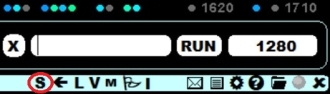
JAGUAR offers a quick "lookup search" for fast checks from the stations on the current frequency/continent.
Search can be triggered using the keyboard key S or clicking TOOLBAR > S. Another press/click (or pressing ESC) closes the bar.
You can use SEARCH fully using the keyboard keys only: just press "S", type what you want to search (no need to use uppercase) and press enter. The default target is TURTLE data on the currently played frequency. You can also change the target by pressing the DOWN arrow key (the search target and functionality will change accordingly).
SEARCH support the following targets:
TARGET = Frequency. Search stations from this frequency . You can use free text search (or for NA you can use the reserved words = Jaguar "shortcats", partial call signs, etc). Phonetic call sign search is automatically applied to NA searches: for example if you search for "KVTO" on AM 1400, the result set contains KVTO and KEDO.
TARGET = DAYLOGS. Search stations that you have logged using DAYLOGs. If a hit is found, the system will jump automatically to that time spot. This is an extremely fast way to find/replay old IDs.
TARGET = FQLIST. Create a dial containing desired frequency list. You can give an ITU abbreviation (for example AFS gives you the frequency list for the AFS stations to be reviewed), the US/CAN state code (for example AB gives you the frequency list for stations in Alberta to be reviewed) . Note that Hawaii is HWA (not HI) in this system and Alaska is ALS (not AK).
TARGET = GOOGLE. Use Google for solving the query.
If you prefer using the mouse as much as possible, you can start SEARCH also by clicking TOOLBAR > S, clicking the last sub window for selecting the search target ( FREQUENCY > DAYLOGS > FQLIST > GOOGLE ) and clicking "RUN" to run the function. Clicking "X" closes the SEARCH window.
More SEARCH functions may be added in the future.
SHORTCATS are pre-defined search keywords for the US/CAN/MEX networks/formats. If ESPN programming is heard on some specific frequency, the user can quickly create a list of stations of the ESPN affiliates on that frequency. Each shortcat consists of 1-4 characters.
The currently available SHORTCATS are as follows:
HITS - stations playing "hits"
OLD - stations playing "oldies" (well, they are "HITS" too)
CW - stations with C&W orientation
NOS - stations with nostalgia / adult standards orientation
SS - spanish speaking stations in USA and Mexico
MEX - Mexican stations
CBC - Canadian CBC stations
REL - religiously oriented stations
RELR - Relevant Radio affiliates
NPR - National Public Radio affiliates
EWTN - EWTN affiliates
ETN - Multicultural ("ethnic") stations: programming language being something else than Spanish or English
FOX - Stations carrying Fox News or Fox Sports programming
ESPN - ESPN affiliates
BIZ - stations with "business talk" orientation
RER - Red Eye Radio affililiates
C2C - Coast-to-Coast affiliates
CC - Coast-to-Coast affiliates (just a faster shortcat for Coast-to-Coast)
In addition to these, the US/CAN state abbreviations (AK, AL, AZ, AR, ...) can be used to show the stations in the given state.
The SHORTCATS have been created with "fuzzy logic": SHORTCATS are based on the language, formats and networks. For example, if you hear Spanish on AM 1400 when DXing North America, you can give the shortcat SS and press ENTER. You will see all the stations from USA and MEX which are tagged with the shortcat SS (in spite of the format listed).
SHORTCATS will support "clues what you hear on the frequency": if you hear "Relevant Radio", you can use the shortcat RELR; if you hear something related to Fox ("Fox Sports" or "Fox News"), you can use the shortcat FOX; if you hear a familiar song or a slogan containing the word "Hits", you can use the shortcat HITS; if you find programming with Christian content, you can use the shortcat REL, etc.
Talk-oriented stations are difficult to categorize, and there is no sense to copy the TURTLE "FORMAT" data here so there are no shortcats as NWS or TLK. Instead, you may try to type in what you hear: at the moment, there are shortcats such as RER ("Red Eye Radio" affiliates) and C2C ("Coast-to-Coast" affiliates), later probably more.
This service can never be perfect, and anyone can say that "no, this is not correct", and he/she is absolutely right: it is very easy to find an exception. For example, the MWLI database lists 71 hits for Red Eye Radio, but the Red Eye Radio web site lists 141 affiliates. We have included those 141 stations even though there seems to be stations which are no more RER affiliates. The same with C2C: there are 415 C2C affiliates on their website but even that is not correct.
However, this feature may be helpful if you just want to make a quick check for "potential hits" on a U.S. frequency based on what you hear. It does not take much time to try.